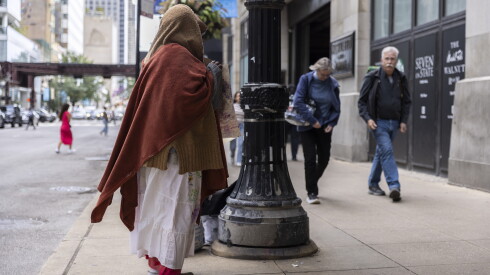
On a mid-July morning when the city’s air is as filthy as any on the planet and many are heeding a warning to stay inside, a woman clutching all of her worldly possessions steps out onto a downtown sidewalk and begins to paint.
A chocolate-brown ribbon soon glistens on her paper, curving into the outline of a woman’s face. A breeze ripples the paper, threatening to carry it away down Randolph Street. The woman mumbles a string of curse words, stabs the paper with her left pointer finger and keeps on painting.
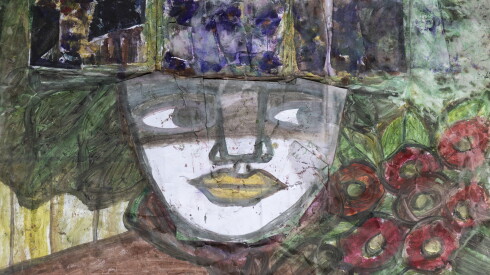
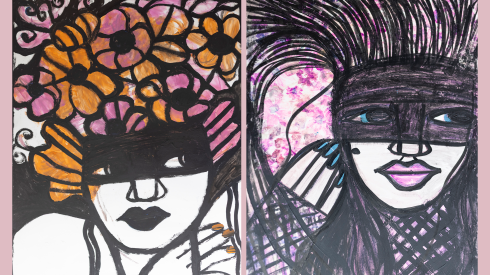
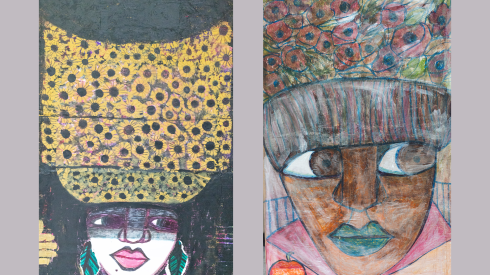
She paints a wide-brimmed hat on her subject, decorating it with gold, purple and pale turquoise petals. She paints in the eyes — sidelong glancing, suspicious.
Twenty minutes later, the woman straightens her 70-year-old frame, steps back and checks her work.
Only one passerby appears to notice the artist at work. The young woman, in a figure-hugging linen dress, regards the painter with a look of confused disapproval.
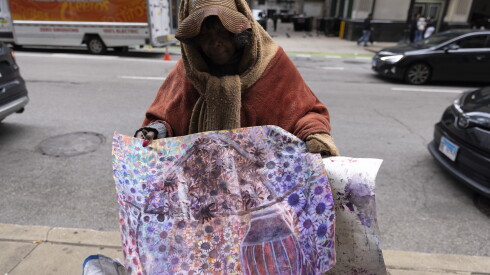
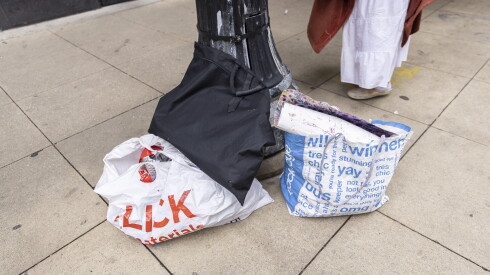
The passerby surely doesn’t know that the artist wearing a floppy straw hat and a star-spangled black sweater in 92-degree heat is Peace Prophet, a homeless African-American woman who paints every day — her studio shifting from the State Street Macy’s to the nearby Blick Art Materials, where she buys most of her supplies.
Nor would the young passerby likely know that Peace Prophet’s work is framed, stacked and otherwise collected in homes across Chicago and beyond. Her work is in galleries and sold at art fairs. Some collectors own hundreds of her paintings.
Francis Fullam, who began collecting her work in 2012, estimates he’s bought close to 1,000 pieces.
“At her best, some of her work is very compelling — it’s fantastic. It’s as good as any outsider artist’s is,” says Fullam, now retired from a marketing research job at Rush University Medical Center.
Fullam uses the term “outsider,” referring to people who are self-taught. But that’s only a guess. Like most people who encounter Peace Prophet, Fullam knows little about her past and how she came to be homeless.
Peace Prophet lives with a mental illness, her family says. A conversation might begin with her asking if you’d like to buy a piece of her art and then rambles into a monologue of how she once starred in a film with Hollywood actor Lloyd Bridges and is, in fact, soon on her way to Los Angeles for the Academy Awards. Or how her family originally came from the Moroccan city of Marrakesh.
None of which turns out to be true. Details of her earlier life — both tragic and inspiring — came to light in early August, when a family member stumbled upon a YouTube talk about Peace Prophet and then reached out to the lecturer.
* * *
Chances are, if you even occasionally head downtown, you have seen Peace Prophet. She’s as much a fixture outside of the State Street Macy’s as the smartly dressed Jehovah’s Witnesses proffering copies of “The Watchtower” magazine. Those who don’t know Peace Prophet’s self-chosen name may still know her as, say, “the homeless artist lady.”
Because that’s what she does. She paints. She draws. Constantly — like a fish that must keep swimming to stay alive.
“I am drawn to people who express themselves unabashedly,’” says Nick Cappelletti, a Saugatuck, Michigan, art gallery owner who has sold Peace Prophet pieces for about the past five years.
* * *
I first searched for Peace Prophet back on a chilly morning in early May. I had just seen her work for the first time at the Intuit Art Museum, an institution in West Town devoted to self-taught artists. Over the next four months, I sought to understand where she came from, why she lives on the streets and the source of her creativity.
Trying to find Peace Prophet can feel like chasing shadows.
“I saw her yesterday,” says a clerk at a downtown Staples, where she often gets free paper.
Try the Dunkin’ Donuts in the subterranean Chicago Pedway, someone else suggests.
No luck.
“She’s been on the street for 20 to 30 years because I’ve been selling StreetWise since 1993. Homeless as a jaybird,” says Lester Cherry, a vendor hawking the weekly magazine outside Macy’s. Cherry hasn’t seen Peace Prophet in several days.
Then on a muggy morning in late May, as downtown rattles to life, she appears — wearing a fleece jacket and a billowy dress. She’s leaning against a bicycle rack in front of Macy’s, her bags of supplies bunched beside her.
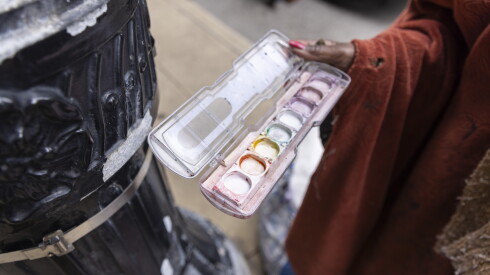
She reaches into one of the bags and tears several sheets from her sketch pad. She pulls out a plastic paint palette, moistening the colors with a dribble of water from an A&W Root Beer bottle.
She has no easel; she doesn’t need one. Sometimes she rests her paper on top of an open bag or the sidewalk. Or she may simply drape it over the flat, tubular part of a bicycle rack. She doesn’t talk while she’s working. She rarely smiles.
She’ll answer questions, to a point.
“That’s $20,” she says when I ask her how much for a painting that resembles a mosaic of jewel-toned glass shards.
I ask her if she feels safe living on the streets.
“I pray every day before I go to bed, ‘Please let me wake up,’” she says without any obvious emotion.
Ask too many questions, and she squints at you, as if the probing is beginning to hurt her eyes.
Then, unprompted, she presses her tongue against what appears to be her one good upper front tooth and says: “I have to get my teeth done next Friday.”
* * *
Some people wonder if the world is taking advantage of Peace Prophet’s talents. Even Fullam admits that her work might be worth more than what he pays, anywhere from $5 to $295 for a particularly large piece. He mostly pays her in art-supply gift cards, which she cashes at Blick’s.
“One of my worries is that no one is looking after her interests,” Fullam says.
He pulls out two black Moleskine notebooks and holds one open. At the top, he’s written, “PP.” Beneath that, he lists every painting (“Large woman with two groups of blue flowers,” “Valentine theme on canvas”), the date he bought it and how much he paid.
He didn’t buy anything at first. For about a year, Fullam would hurry past the artist on his way to work, without even making eye contact.
One day, he noticed she was holding up a postcard-size painting.
“I went up to her and said, ‘How much is it?’ She said, ‘Whatever you want to give me,’’’ Fullam recalls. “I kept seeing her. I would bring [the paintings] home and my wife says, ‘We don’t have any more wall space.’”
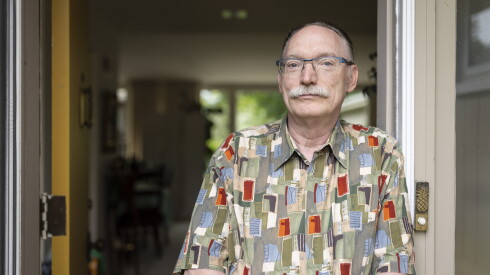
With a neatly clipped white mustache, pale skin and slicked-back thinning hair, Fullman brings to mind a British drill sergeant. He has a quiet voice and a teasing gleam in his eyes when he talks.
Asked why he has collected so many Peace Prophet paintings, he jokes: “I don’t drink. I don’t smoke. I gave up the fountain pens.”
Then, becoming serious, he says he both loves her work and wants to help someone who needs it.
In years past, Fullam rented a booth to sell her paintings at an outsider art fair in Harbert, Michigan, just north of New Buffalo. The paintings, framed, sell for as much as $600, says Judith Racht, owner of the eponymous gallery that puts on the fair.
Racht says she currently has 10 Peace Prophet works on her gallery walls. There is something “soulful” about the artist’s work, and it has an “everyman” quality to it, Racht says.
Peace Prophet’s works taps into the sense of isolation that all humans feel at one time or another, she says.
“Even if we are not homeless, we feel alone — like she must feel,” Racht says.
Cherie Giller bought a Peace Prophet female portrait at Nick Cappelletti’s gallery.
“I felt like when I was walking around the room looking at all the other pictures he had on display, it was like her eyes kept following me,” Giller says. “I said to my husband, ‘What do you think of this? Because I really, really like it.’ He said, ‘Well, then we should get it.’”
Fullam says that after paying the $600 booth fee for the art fair each year, he has a “manageable loss.” In other words, some years he doesn’t sell enough to cover the booth fee; while “some years I have sold considerably more. And all the money I collect — and then some — gets recycled to buy more,” Fullam says.
“We just do this to get [Peace Prophet] better known,” he says.
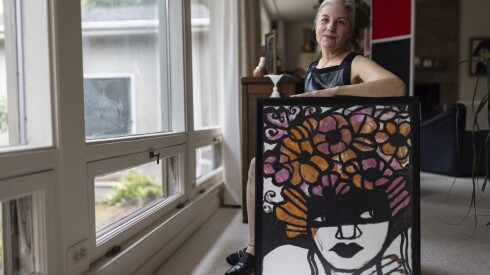
Geri Biamonte, a social worker at the University of Illinois-Chicago, is another collector. She first met Fullam about 10 years ago, when he noticed her holding a Peace Prophet painting on a Pink Line L train.
“The city is full of varied and talented people, but she is something else,” Biamonte says. “I want to believe that there is a well out there of endless possibility and maybe in her unique ability, she has a unique access to that spigot. For her, it just doesn’t turn off.”
Both Fullam and Biamonte say they’d like to do more for Peace Prophet. Biamonte even tried to talk to her about finding a place to live away from the streets. Peace Prophet wasn’t interested.
“My take on it is if she had a place, she wouldn’t use it. She needs her freedom,” Fullam says.
Linsey Maughan, a spokeswoman for the Chicago Department of Family & Support Services, told the Sun-Times the agency has offered her services, but she has always refused. Peace Prophet has even rejected her own family’s offers.
* * *
Peace Prophet is a true original, and her work is part of a freewheeling artistic tradition whose practitioners have included spiritual mediums and those locked away in psychiatric institutions.
The French artist Jean Dubuffet, who died in 1985, coined the term “art brut” to describe this sort of work. “He thought most academic, mainstream art was crap. He thought it was just garbage, just fashion,” says Michael Bonesteel, a Chicago-based author who has written extensively about self-taught artists.
Perhaps Chicago’s best known “outsider” artist is Henry Darger, a reclusive janitor who died in 1973, leaving behind a room on the North Side cluttered with dozens of pairs of broken eyeglasses, hundreds of his own watercolors, collage paintings and, in a trunk, a 15,000-page typed fantasy novel titled “In the Realms of the Unreal.” Darger, much of his artwork epic in scope, is considered one of the world’s great self-taught artists.
“Almost everything in his work is appropriated. It’s swiped. It’s taken from other sources. … He’s found the glue to bring it all together,” says Bonesteel, author of the 2000 book “Henry Darger: Art and Selected Writings.”
Mention homeless artists, and, invariably, someone will bring up Lee Godie, who for years was a colorful fixture outside of the Art Institute of Chicago. She is best known for her portrait sketches and photo-booth selfies, which she often daubed with paint or ink.
There has been a groundswell of public support in recent years for self-taught art and artists, but it’s still not given the respect it deserves, Bonesteel says.
“Even today, there is a strong institutional bias against it from people who are trained. There is a kind of veiled bigotry toward it,” he says.
* * *
One day in June, Peace Prophet is in the basement of Blick’s, bent over a drawer filled with sheets of art paper. She buys three, handing the cashier two crumpled dollar bills. She heads back out onto the streets.
Is she available to chat?
“I don’t have time today. I’m waiting for someone,” she says brusquely.
Who?
“My daughter.”
Peace Prophet paints, to the accompaniment of a wailing police siren, the rumble of a passing L train and a chorus of drills biting into concrete.
An hour later, the white paper is awash in vibrant color — a Black woman with a wide-brimmed hat, resembling a Nigerian churchgoer in her Sunday best.
There is no sign of Peace Prophet’s daughter.
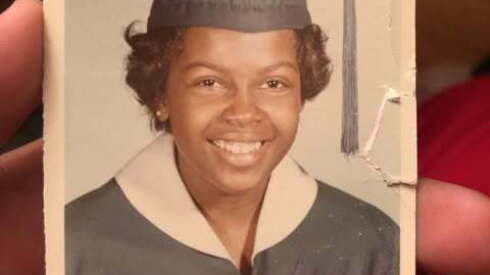
But as it turns out, the daughter is no figment of her imagination. Peace Prophet has four children, all grown, and eight grandchildren. They know her as Janice Carol Rivers, born at the old St. Luke’s Hospital in the South Loop on July 30, 1955, according to Cook County Clerk’s Office records.
Peace Prophet’s remarkable story begins to trickle out in late July after her son found on YouTube a talk Biamonte, the UIC social worker and collector, had given in 2019 about the artist and her work.
The son shared his discovery with his siblings. “We were blown away. Our mom has struggled with mental illness our entire lives. … I haven’t seen her since 2024,” Peace Prophet’s youngest daughter writes in a July 13 Facebook message to Biamonte.
Janice Rivers was a quiet, serious child who, to hear her only surviving sibling describe it, was born with a paint brush in her hand.
“She was always painting, drawing, coloring,” says the brother, born James, but who later converted to Islam and now goes by Hakim Abdul-Ahad and lives in Las Vegas.
In the family’s yellow-brick Woodlawn apartment, Janice kept an easel, she stretched her own canvases. She devoured books about Picasso, Van Gogh, her brother says. She listened to French language instruction on old 45 rpm records.
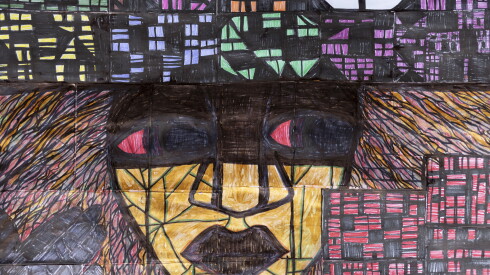
Peace Prophet’s youngest daughter has a theory about the woman who appears so often in Peace Prophet’s work, the one with the sidelong glance. “It’s depicting her mental illness in a drawing,” she says. “The way the person is always looking off [to the side], to me it’s encapsulating paranoia, always looking over your shoulder.”
Manuel Martinez/WBEZ
“She wanted to go to France to study art,” Abdul-Ahad says.
The brother remembers something else: an explosive temper.
“She would snap. She would go off the deep end,” the brother says.
He remembers his sister getting into an argument over something petty with a boy in fourth grade.
“She raked his face like a lion,” the brother said.
When Abdul-Ahad approached his mother about Janice’s odd behavior, she dismissed it as “eccentricity,” he says.
Whatever her problems, they didn’t stop Janice from excelling in Catholic schools on the South Side, graduating from Unity Catholic High School in 1973. Nor attending DePaul University, where she met her future husband and, the university confirmed to the Sun-Times, earned a bachelor’s degree in sociology in 1978.
She would go on to have four children — three girls and a boy. Three of Peace Prophet’s children agreed to speak to the Sun-Times, but only if we used either just a first name or no name at all.
Gaia, the oldest and now 45, remembers the pair frequently hopping on the Green Line from the South Side to get downtown.
“We went to the library almost every week. … I could read when I was in kindergarten,” Gaia says. “She laid a very strong foundation for me, just teaching me how to read gave me the power to learn so many things.”
Gaia, now a civil engineer, also recalls her mother’s social work at the since-demolished Ida B. Wells housing project in Bronzeville.
“There was this one thing she was so proud of,” Gaia says. “She helped write a grant, and she was able to get the money for a new playground.”
Peace Prophet’s other daughters also speak of a devoted mother. The youngest, a musician living in Los Angeles, is now 31. Her childhood memories of her mother are few and foggy, but she’s never forgotten the time she broke her nose after taking a tumble from her bicycle.
“I have a memory of her cuddling me and putting me in the bathtub,” the daughter says.
But darker memories color the past too — of a mother who flew into sudden, unexplained rages with the children’s father and who made nonsensical accusations.
“She started accusing me of different things. She felt like I wasn’t on her side,” Gaia says.
Gaia’s father, who died in 2007 of complications from heart disease, would eventually gain full custody of all four of his children, moving them to suburban Willowbrook. Gaia says she was a sophomore in high school and on her way to a homecoming dance when she visited her mother at a local hospital. There, doctors told the family that the patient had bipolar disorder, which causes alternating bouts of mania and depression.
Peace Prophet took medicine for a time, but hated the way it made her feel, her daughters say — and so she stopped. Her illness seized control. She bounced from apartments to a group home and, eventually, to the streets in the year 2000, Gaia says.
“She just left and that was it,” Gaia says. “She was gone.”
That left Gaia to fill the mother void for her three much younger siblings when she was still in high school; even so, she is not bitter.
“Given that it was beyond her control, I couldn’t really be mad at her,” Gaia says.
Peace Prophet’s youngest, the musician, says all the children are affected in different ways by their mother’s absence.
“The pain that I feel about her is more so about the fact that I’m sure at 25 years old, she never thought she was going to be a homeless lady at 70,” she says. “It just makes me sad thinking about all that she’s missed out on.”
The family has tried many times, the daughter says, to give Peace Prophet a better life. Even when she agrees to visit one of her children, Peace Prophet is always eager to return home; for her, that’s the streets.
The youngest daughter searches for her mother whenever she is back in Chicago from the West Coast. She went on one such hunt with her brother in 2019. They searched all day, went to a night club, then finally found their mother at 3 a.m., curled up inside the revolving door of a downtown bank.
“We didn’t know for sure it was her. We were like, ‘Hey Mom.’ … Somebody started unzipping the bag, and she poked her eye out and it was her,” the daughter says.
Their mother’s connection with strangers through art is welcome but bittersweet, the daughters say.
“This is amazing that so many people love her art. But it made me sad. I know in her mind right now she’s not fully capable of understanding how much people love and enjoy her art,” says Tina, the middle daughter, who works as a phlebotomist and lives in Burr Ridge.
The youngest daughter has a theory about the woman who appears so often in Peace Prophet’s work, the one with the sidelong glance.
“It’s depicting her mental illness in a drawing,” she says. “The way the person is always looking off [to the side], to me it’s encapsulating paranoia, always looking over your shoulder.”
Others have said the woman in the painting illustrates the way many people treat the homeless: unwilling to look them directly in the eye.
* * *
It’s Lollapalooza weekend, and the streets across from Grant Park teem with glittered-up, flesh-baring youth. It’s a bad day to try to find Peace Prophet. But it’s her birthday. She’s 71 years old. Her youngest daughter, the L.A. musician, wants to wish her a happy birthday, something she has never done.
The daughter, reaching out from Los Angeles, asks if the Sun-Times can take a phone along with us to make that happen. We are happy to help.
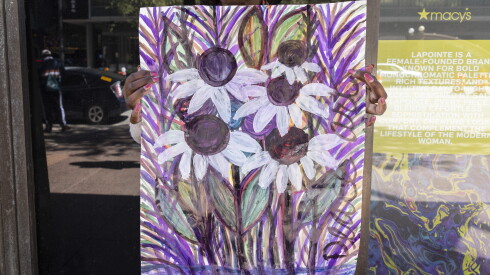
Peace Prophet is nowhere to be found. We make four loops of her typical stomping grounds, head underground, resurface. We’re about to give up when we see a sweater-clad woman on the north side of the State Street Macy’s. It’s her. She’s holding up a painting, still wet, that looks like stalks of fresh lavender laid out on a table.
“We have a surprise for you,” I say.
Peace Prophet looks at the cell phone and at the young African-American woman and child huddled on the screen.
She peers closer. The armor of distrust falls away. She smiles — a wide, toothy grin.
“I love you, Mommy. I hope you have a good birthday today,” the daughter says.
“I’m doing this art thing, hustling around,” Peace Prophet says.
She isn’t sure how old she is today, maybe 69, 39, 80.
“You’re 71,” her daughter says.
Then Peace Prophet’s granddaughter begins to sing, her voice piercing the roar of traffic and the pedestrian chatter just a few feet away.
“Happy birthday to you, happy birthday, Grandma Janice, happy birthday to you!”
Peace Prophet stares transfixed at the screen and then says, in a whisper, “I love you.”
Still holding up the painting she hopes someone will buy today for a few dollars, Peace Prophet declares: “It’s the best birthday I ever had.”
Contributing: Alina Edwards